 ALSOFOUNDIN
Titanium Dioxide (TiO₂)
Banned in EUOut of EU food since 2022. Still whitening US candy and icing. Also listed on labels as E171, TiO₂, CI 77891, artificial color.
E-number: E171
What it is
A mineral white pigment — the brightest white in common use, the same compound that whitens paint, sunscreen, and toothpaste. In food it's E171: a fine powder that makes candy shells opaque, icing bright, and other colors pop.
Why it's in food
White is the hardest color to fake naturally. Titanium dioxide delivers pure, stable opacity in tiny amounts — it's why powdered donuts glow and candy coatings look flawless instead of translucent and gray-ish.
US vs EU status
United States
FDA-approved at up to 1% of a food's weight, and it isn't part of the 2025 petroleum-dye phase-out since it's a mineral, not a petro-dye. One transparency catch: as a certification-exempt color, US labels can list it as just 'artificial color' or 'color added' — it doesn't have to be named. A famous 2022 lawsuit over Skittles put it in headlines; the case was dismissed, but the reformulation pressure stayed.
European Union
Banned in food across the EU since August 2022. Europe's regulator concluded it could no longer rule out genotoxicity — the possibility that nanoparticles in the powder damage DNA — so it withdrew approval as a precaution. Here's the twist: the UK and Canada reviewed the same evidence and kept it legal. One dossier, three governments, two answers.
Common products
- Candy shells and chewing gum (Skittles is the famous one)
- Powdered donuts and pastries
- Frosting, icing, and cake decorations
- Coffee creamers and white sauces
- Marshmallows and white candies
- Pill coatings on medicines and supplements — one of its biggest uses
Cleaner swaps
- Products that skip the whitener — duller color is the tell, and the point
- Rice starch in some reformulations
- Calcium carbonate in certain uses
Case note
Three regulators read one dossier: Brussels banned it, London kept it, Ottawa kept it. The molecule didn't change between capitals — the appetite for doubt did. And on a US label it can hide behind two words, 'color added,' which is the quietest thing an investigated ingredient gets to do.
Read the full investigation: Also Found In: Titanium Dioxide →
FAQ
Why did the EU ban titanium dioxide?
Precaution, not proof. In 2021 Europe's food safety authority said it could no longer rule out that E171's nanoparticles damage DNA, and under EU logic, 'can't rule it out' was enough to pull approval by August 2022. No study proved harm at food doses — the ban is about unresolved doubt, which is exactly what makes the file interesting.
Is it banned in the UK or Canada?
No. Both reviewed the same evidence after the EU ban and kept titanium dioxide legal — the UK's food agency and Health Canada each concluded the safety concerns weren't supported at real-world exposures. Same data, opposite laws, depending on how much doubt a regulator is willing to live with.
How do I spot it on a US label?
Sometimes you can't by name. It may be listed as 'titanium dioxide (color)' — or legally buried as just 'artificial color' or 'color added,' since it's exempt from batch certification. The reliable tells are the products themselves: hard candy shells, bright white icing, powdered donuts, and coated pills.
Is it the same titanium dioxide as in sunscreen?
Same compound, different context. In sunscreen it sits on your skin and blocks UV — regulators everywhere consider that use fine. The EU's food question was specifically about swallowing nanoparticles day after day. One molecule can have two files depending on the door it enters through.
The Full File
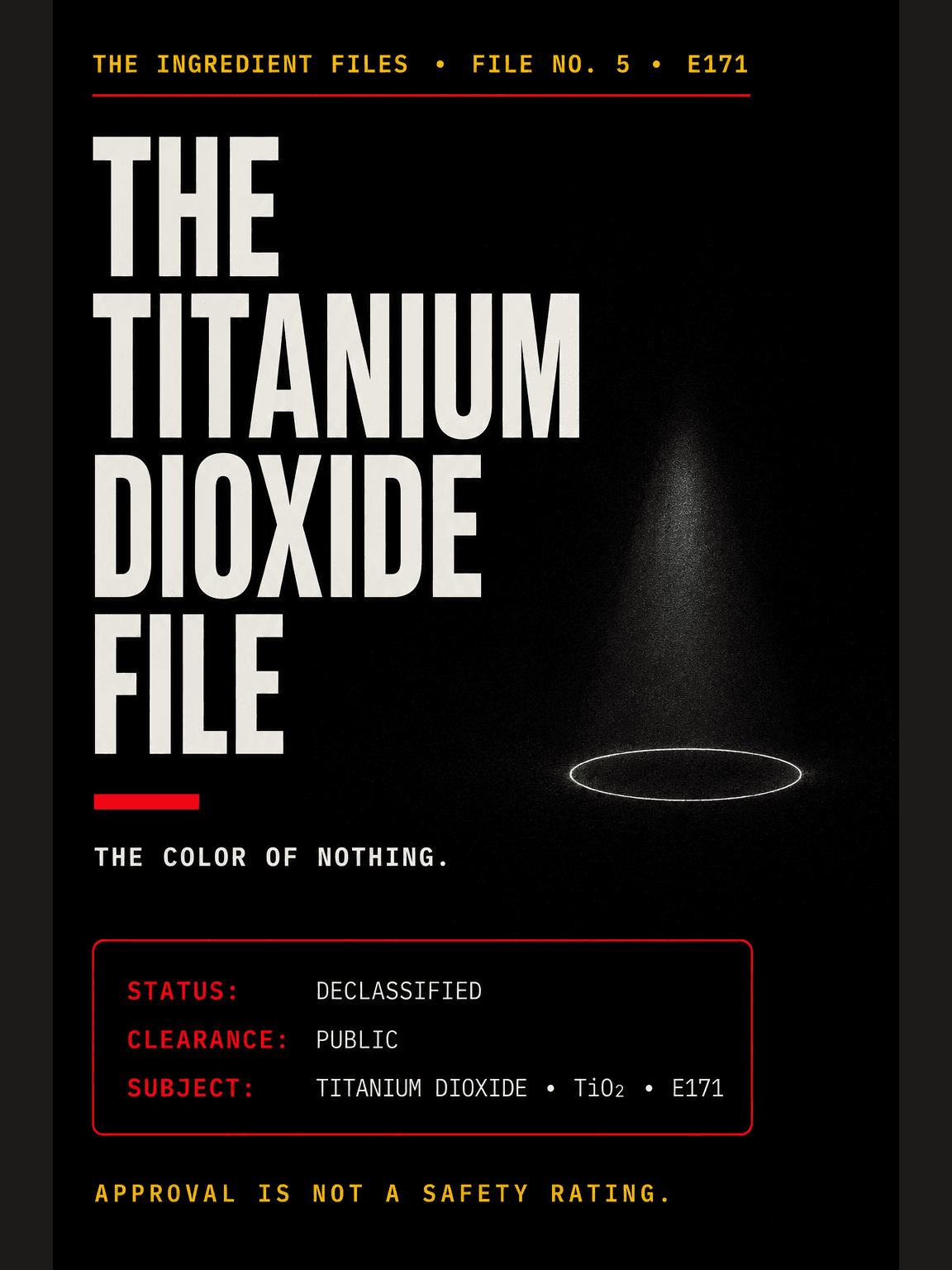
The Titanium Dioxide File
The Color of Nothing.
How the FDA decides what reaches your table and your medicine cabinet — and how it learned to decide.
Related files
Red 40 Allura Red AC
Legal in the US. Child-behavior warning in Europe.
Open file →Yellow 5 Tartrazine
The original 'hyperactivity' dye — warning-labeled across the EU.
Open file →Yellow 6 Sunset Yellow FCF
Same EU warning label as Yellow 5. Same silence on US boxes.
Open file →Red 3 Erythrosine
FDA revoked it in 2025 — 35 years after pulling it from cosmetics.
Open file →