 ALSOFOUNDIN
Yellow 5 (Tartrazine)
EU Warning LabelThe original 'hyperactivity' dye — warning-labeled across the EU. Also listed on labels as Tartrazine, E102, FD&C Yellow No. 5, CI 19140.
E-number: E102
What it is
A synthetic lemon-yellow dye made from petroleum, in the food supply for over a century. On labels it also appears as tartrazine or E102, and it's one of the most-used dyes on earth — often blended with Blue 1 to make greens.
Why it's in food
It's the cheapest, most stable yellow there is — surviving heat, light, and acid that would wash out turmeric or saffron. A trace of it turns pale food 'lemony' and keeps every batch identical.
US vs EU status
United States
FDA-approved — but with a distinction no other early dye earned: since 1981 the FDA has required Yellow 5 to be declared by name on labels because a small group of people, especially aspirin-sensitive ones, react to it with hives or asthma-like symptoms. It's on the 2025 FDA phase-out list, in West Virginia's ban, and barred from California school food from the end of 2027.
European Union
Permitted as E102, but it was one of the six dyes in the 2007 Southampton hyperactivity study — so any EU food containing it must warn that it 'may have an adverse effect on activity and attention in children.' Many European manufacturers switched to natural yellows rather than print that sentence.
Common products
- Mountain Dew and other citrus sodas
- Boxed mac and cheese (many brands)
- Peeps and yellow candies
- Cheese-flavored chips and crackers
- Pickles and some relishes
- Gummy vitamins and children's medicines
Cleaner swaps
- Turmeric
- Annatto
- Beta-carotene
- Saffron (the expensive option)
Case note
A century in the food supply, and it's the one dye the FDA itself put on permanent roll call — required by name on every label since 1981 because some people's bodies object. When the agency that approves a molecule also makes it announce itself, that's not a clean file. That's a file with an asterisk.
FAQ
Is Yellow 5 banned in Europe?
No — like Red 40, it's legal in the EU but must carry the child-behavior warning label. The practical effect was the same as a ban for many products: European versions of American brands often use turmeric or beta-carotene instead, so the identical item can be dye-free in Paris and dyed in Phoenix.
Why do labels say 'contains Yellow 5' specifically?
Because the FDA singled it out. Since 1981, Yellow 5 must be named on food and drug labels — a rule created after documented reactions like hives and asthma-like symptoms, particularly in people sensitive to aspirin. The reactions are rare, but rare enough to matter is exactly why the roll call exists.
Does Yellow 5 lower testosterone or sperm count?
No — that's a 1990s internet legend, usually aimed at Mountain Dew. No credible study supports it. The documented concerns are different: allergic-type reactions in sensitive people and the contested hyperactivity link that triggered Europe's warning label. Real files don't need fake charges.
Does Yellow 5 affect children's behavior?
Contested, same as Red 40. The 2007 Southampton study tested dye mixtures including tartrazine and found increased hyperactivity, which is why the EU warning exists. The FDA maintains most children aren't affected while acknowledging some may be sensitive; a 2021 California review sided with the sensitive-kids reading.
The Full File
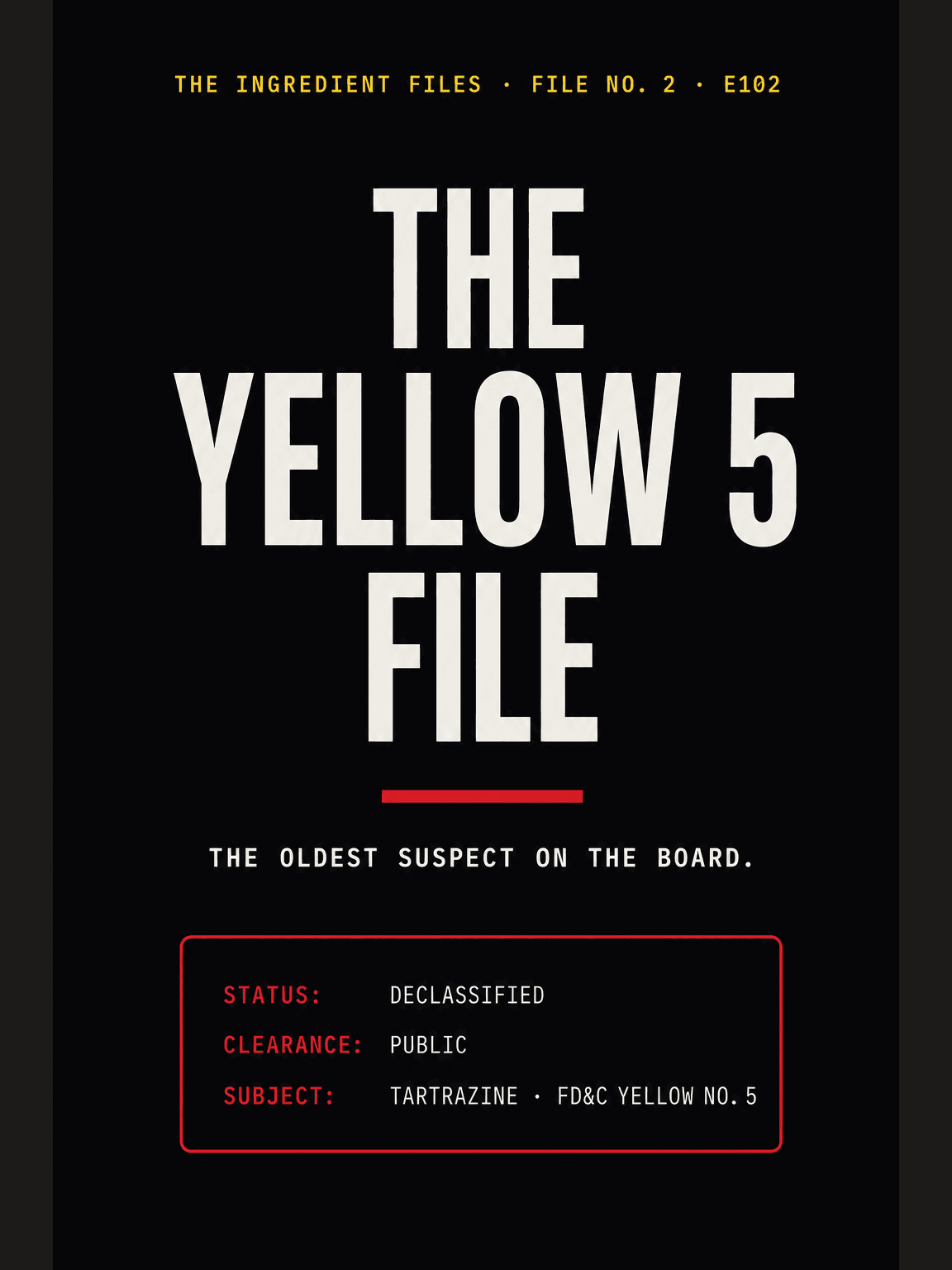
The Yellow 5 File
The Oldest Suspect on the Board.
How the FDA decides what reaches your table and your medicine cabinet — and how it learned to decide.
Related files
Red 40 Allura Red AC
Legal in the US. Child-behavior warning in Europe.
Open file →Yellow 6 Sunset Yellow FCF
Same EU warning label as Yellow 5. Same silence on US boxes.
Open file →Red 3 Erythrosine
FDA revoked it in 2025 — 35 years after pulling it from cosmetics.
Open file →Titanium Dioxide TiO₂
Out of EU food since 2022. Still whitening US candy and icing.
Open file →