 ALSOFOUNDIN
Red 3 (Erythrosine)
US Ban · 2025FDA revoked it in 2025 — 35 years after pulling it from cosmetics. Also listed on labels as Erythrosine, E127, FD&C Red No. 3, CI 45430.
E-number: E127
What it is
A cherry-pink synthetic dye — chemically unrelated to Red 40 — that gave maraschino cherries and holiday candy their glow for decades. It contains iodine and belongs to an older family of dyes than the azo reds.
Why it's in food
Nothing else produces that exact luminous pink-red. It made cherries look like cartoon cherries and candy look lit from inside — which is why manufacturers kept using it long after the questions started.
US vs EU status
United States
This is the file where the system indicted itself. In 1990 the FDA banned Red 3 from cosmetics and skin-applied drugs after it caused thyroid tumors in male rats — then left it in food for 35 more years. In January 2025 the FDA finally revoked it for food and ingested drugs; companies have until January 2027 to get it out of food. California had already banned it statewide in 2023, effective 2027.
European Union
Europe all but shelved it decades ago: E127 is permitted only in cocktail and candied cherries — a single legacy exception — and effectively nothing else. While the US debated, the EU had already reduced it to a garnish.
Common products
- Maraschino and candied cherries
- Candy corn and conversation hearts
- Some strawberry milks and drink mixes
- Cake-decorating gels and icings
- Cough syrups and gummy vitamins
- Still legal on US shelves until January 2027 — check labels
Cleaner swaps
- Beet juice or beet powder
- Carmine (natural but insect-derived — not vegan)
- Black carrot concentrate
- Cherries dyed with fruit and vegetable juices
Case note
Banned from lipstick in 1990 because rats grew tumors. Kept in candy until 2027 because nobody finished the paperwork. Red 3 is the library's proof that 'approved' can mean 'pending' for 35 years — and the open question it leaves behind is what else is still waiting on paperwork.
FAQ
Why was Red 3 banned?
High doses caused thyroid tumors in male rats, and a US law called the Delaney Clause forbids approving any additive shown to cause cancer in animals. That's what forced the 1990 cosmetics ban. The FDA notes the rat mechanism likely doesn't apply to humans at food doses — but the law is the law, which made the 35-year delay for food even harder to defend.
Is Red 3 still in stores?
Yes. The 2025 revocation gave food makers until January 2027 to reformulate (ingested drugs get until 2028), so products with Red 3 are legally on shelves right now. If the label says Red 3 or erythrosine, that's the one — this is a rare case where reading the label beats trusting the ban.
Is Red 3 the same as Red 40?
No — different chemistry, different rap sheet. Red 3's case is about cancer findings in animals and a legal clause; Red 40's is about children's behavior and Europe's warning label. Red 40 remains federally approved. Sharing a color name is all they have in common.
Why did it take 35 years after the cosmetics ban?
Bureaucratic unfinished business. The 1990 action covered cosmetics and skin-applied drugs, and the FDA said it intended to address food — then didn't, until advocacy groups petitioned in 2022 and California banned it in 2023. The January 2025 revocation closed a loop the agency itself had left open since the first Bush administration.
The Full File
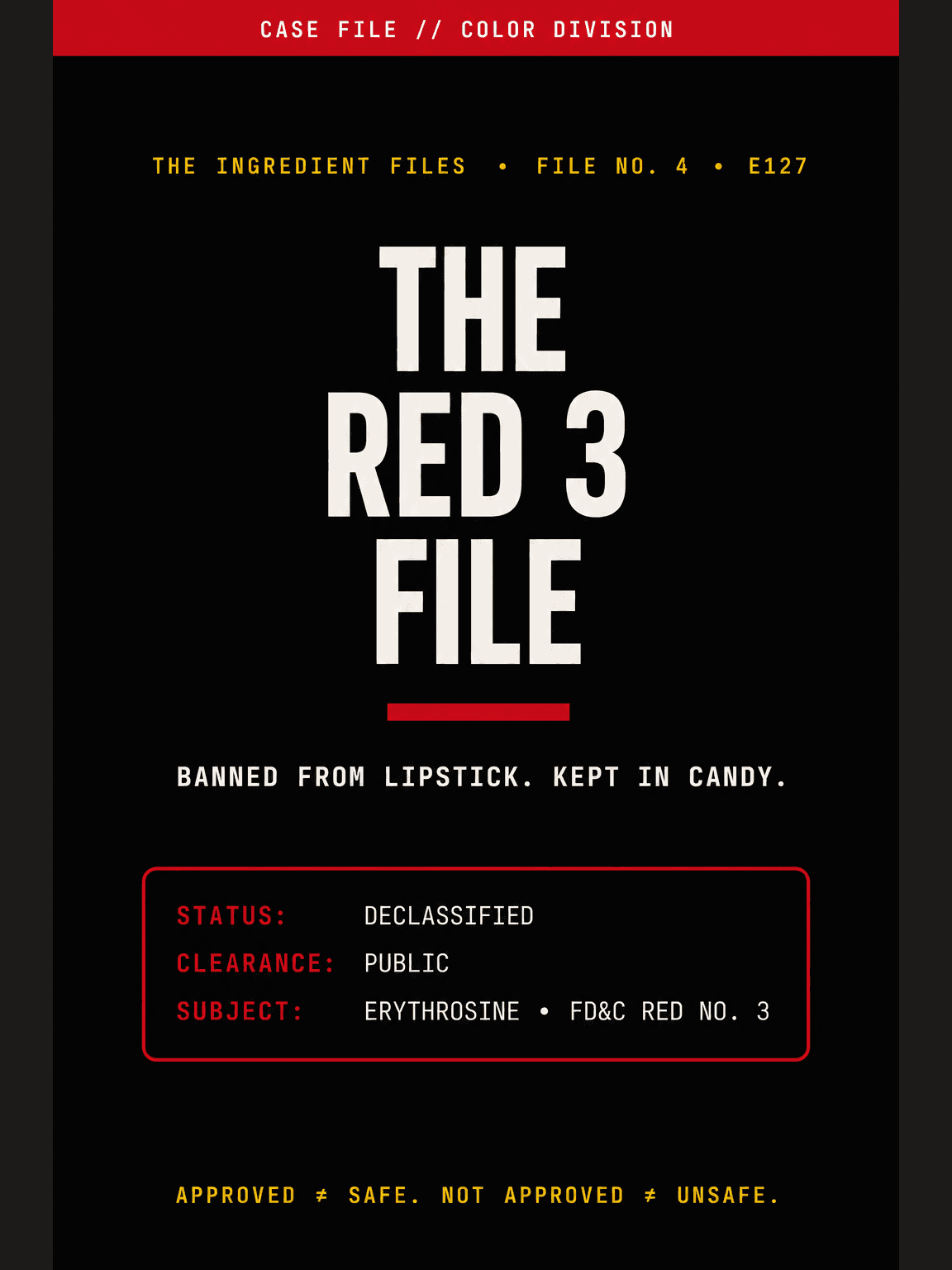
The Red 3 File
Banned from Lipstick. Kept in Candy.
How the FDA decides what reaches your table and your medicine cabinet — and how it learned to decide.
Related files
Red 40 Allura Red AC
Legal in the US. Child-behavior warning in Europe.
Open file →Yellow 5 Tartrazine
The original 'hyperactivity' dye — warning-labeled across the EU.
Open file →Yellow 6 Sunset Yellow FCF
Same EU warning label as Yellow 5. Same silence on US boxes.
Open file →Titanium Dioxide TiO₂
Out of EU food since 2022. Still whitening US candy and icing.
Open file →