 ALSOFOUNDIN
Yellow 6 (Sunset Yellow FCF)
EU Warning LabelSame EU warning label as Yellow 5. Same silence on US boxes. Also listed on labels as Sunset Yellow FCF, E110, FD&C Yellow No. 6, CI 15985.
E-number: E110
What it is
An orange synthetic dye and Yellow 5's close chemical cousin — the color of cheese puffs, orange soda, and candy corn. Petroleum-derived, and known in Europe as Sunset Yellow.
Why it's in food
It delivers the exact 'cheese orange' and 'orange-drink orange' consumers expect, at a fraction of the cost of paprika or carrot extracts — and it never fades on the shelf.
US vs EU status
United States
FDA-approved with no warning requirements. Like the other petroleum dyes, its clock started in 2025: it's on the FDA's voluntary phase-out list, banned in West Virginia's law, and barred from California school food from the end of 2027. Big brands including Kraft dropped it from products like mac and cheese years earlier under consumer pressure.
European Union
Permitted as E110 with the mandatory child-behavior warning label — it was one of the Southampton six. Europe's regulator has also wobbled on the dose: in 2009 it slashed the acceptable daily intake to 1 mg/kg, then in 2014 raised it back to 4 mg/kg after new data. Even the referees change the call.
Common products
- Cheese-flavored snacks like Cheetos and Doritos
- Orange sodas, including US Fanta
- Candy corn and orange candies
- Gelatin desserts and drink powders
- Some breading and boxed dinner mixes
- Orange-colored medicines and vitamins
Cleaner swaps
- Annatto
- Paprika extract
- Beta-carotene
- Carrot or pumpkin concentrates
Case note
Run the Fanta test in any airport: carrots in the London bottle, petroleum in the Dallas one. The recipe didn't change because the science differed — it changed where a label forced the company to say the quiet part out loud.
FAQ
Is Yellow 6 banned in Europe?
No — legal with the warning label. The cleanest illustration is Fanta: the US orange version is colored with Yellow 6 and Red 40, while the UK version gets its orange from sources like carrot and pumpkin concentrates. Same company, same drink, two recipes — the difference is one mandatory sentence on the label.
What's the difference between Yellow 5 and Yellow 6?
They're sibling azo dyes: Yellow 5 is lemon-yellow, Yellow 6 is orange. They share the petroleum origin, the Southampton-study baggage, and the EU warning label — and they're frequently used together. If a snack is 'cheese-colored,' Yellow 6 is usually the one doing the work.
Does Yellow 6 contain carcinogens?
The dye itself isn't classified as one, but its manufacturing can leave trace impurities — including benzidine, a known carcinogen — which is why the FDA batch-certifies every lot to keep those traces under strict limits. Regulators call the residual levels negligible; critics answer that a molecule with zero nutritional value shouldn't get to carry any.
Does Yellow 6 affect children's behavior?
It carries the same contested evidence as the rest of the Southampton six: the 2007 study of dye mixtures triggered Europe's warning label, the FDA says most children are unaffected, and California's 2021 review concluded some children are sensitive. The science hasn't settled; the labels just landed differently.
The Full File
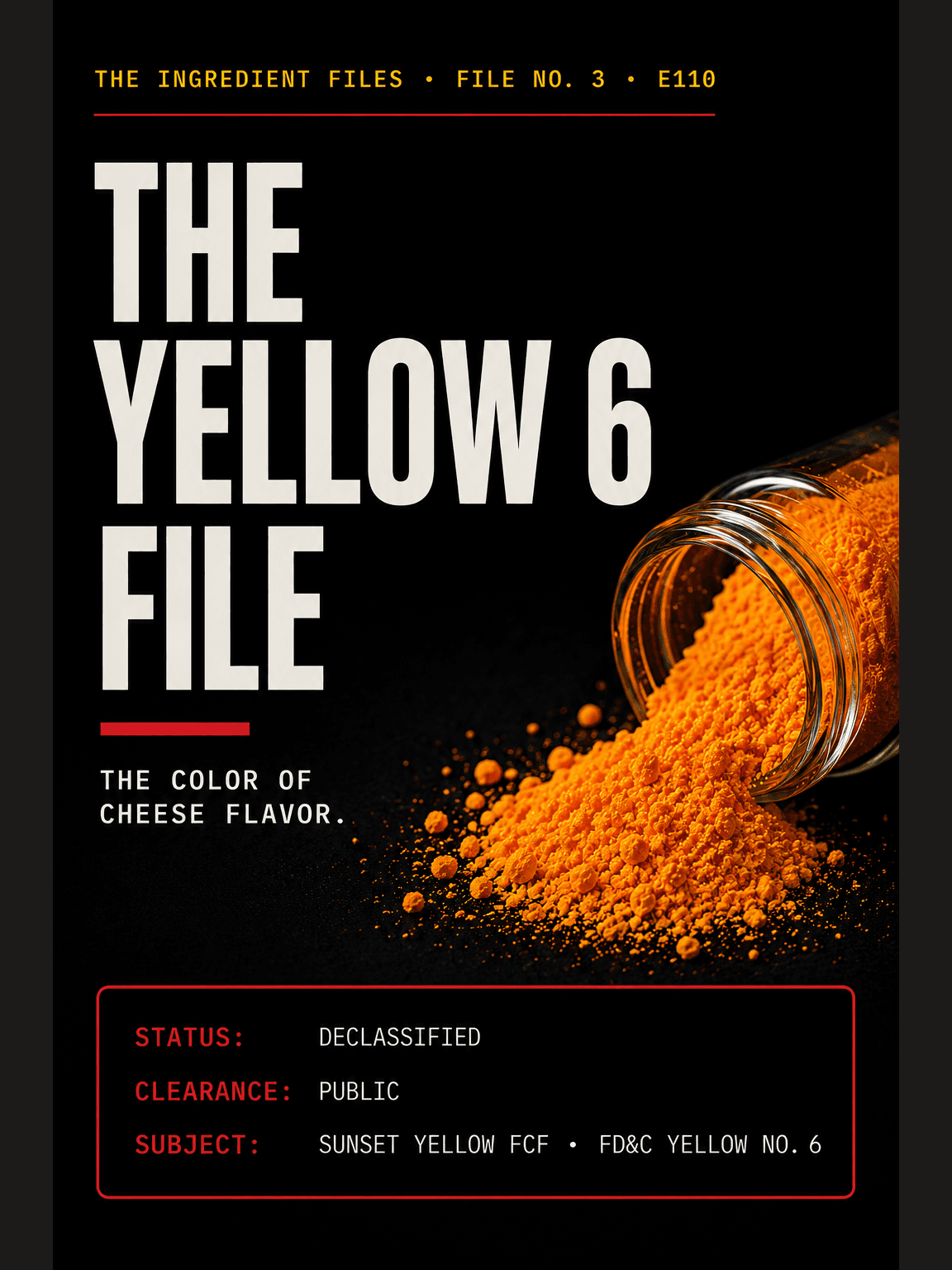
The Yellow 6 File
The Color of Cheese Flavor.
How the FDA decides what reaches your table and your medicine cabinet — and how it learned to decide.
Related files
Red 40 Allura Red AC
Legal in the US. Child-behavior warning in Europe.
Open file →Yellow 5 Tartrazine
The original 'hyperactivity' dye — warning-labeled across the EU.
Open file →Red 3 Erythrosine
FDA revoked it in 2025 — 35 years after pulling it from cosmetics.
Open file →Titanium Dioxide TiO₂
Out of EU food since 2022. Still whitening US candy and icing.
Open file →