 ALSOFOUNDIN
Red 40 (Allura Red AC)
EU Warning LabelLegal in the US. Child-behavior warning in Europe. Also listed on labels as Allura Red AC, E129, FD&C Red No. 40, Red 40 Lake, CI 16035.
E-number: E129
What it is
A synthetic red dye made from petroleum — the most widely used food coloring in America. It took over after Red 2 was banned in 1976, and it now shows up in more products than any other dye, from candy to cough syrup. On labels it also hides as Allura Red AC, E129, or Red 40 Lake.
Why it's in food
It's cheap, vivid, and nearly indestructible — stable through heat, light, and acid where natural reds fade to brown. A small amount of Red 40 does the coloring work of truckloads of beet juice, which is exactly why manufacturers reach for it first.
US vs EU status
United States
FDA-approved and batch-certified — no federal ban. But the ground is shifting: in April 2025 the FDA asked industry to phase out petroleum-based dyes voluntarily by the end of 2026, West Virginia passed a statewide ban (school meals from August 2025, all food sold in the state from 2028), and California barred it from public school food starting at the end of 2027.
European Union
Permitted as E129 — but any food containing it must carry the warning 'may have an adverse effect on activity and attention in children,' required EU-wide since 2010 after the 2007 Southampton study linked dye mixes to hyperactivity. The label is unwelcome enough that many European brands reformulated with natural colors just to avoid printing it.
Common products
- Candy — red Skittles, red M&M's, fruit snacks
- Red sports drinks, sodas, and Kool-Aid
- Breakfast cereals like Trix and Cap'n Crunch Berries
- Flavored chips, including Doritos
- Frostings, red velvet mixes, and gelatin desserts
- Children's cold medicines, gummy vitamins, and strawberry-flavored anything
Cleaner swaps
- Beet juice or beet powder
- Black carrot or purple carrot concentrate
- Radish and purple sweet potato extracts
- Carmine (natural, but insect-derived — not vegan)
Case note
Red 40 is the perfect first file: the same molecule and the same studies produced a shrug in Washington and a mandatory warning label in Brussels. When two governments read identical evidence and only one warns your kids, 'approved' stops being an answer. That gap is the reason this library exists.
Read the full investigation: Red 40: The Dye in Your Food That's Also Used in Fabric →
FAQ
Does Red 40 cause hyperactivity or ADHD?
The evidence is contested. A 2007 UK study (the Southampton study) linked mixtures of six dyes to increased hyperactivity in children, which triggered the EU warning label. The FDA's position is that most children aren't affected but some may be sensitive, and a 2021 California state review concluded synthetic dyes can affect behavior in some children. Same studies — different governments drew different lines.
Is Red 40 the same as Red 3?
No. Red 3 (erythrosine) is a different dye that the FDA revoked in January 2025 over cancer findings in animal studies. Red 40 remains federally approved — the pressure on it is about behavior in children, not cancer.
Is Red 40 vegan?
Yes — Red 40 is synthetic, built from petroleum feedstocks, with no animal-derived inputs. The complication is what replaces it. Carmine (also listed as cochineal extract or Natural Red 4) is one of the most common natural red substitutes, and it's made from insects, which makes it non-vegan and a documented rare allergen. So a product that swaps "artificial color" for "natural color" may have moved further from a vegan label, not closer. If vegan status is the goal, read what came in — beet juice, black carrot, and paprika are plant-derived; carmine is not. Note also that some vegans avoid synthetic dyes over animal testing, which is a separate question from ingredient origin.
What is Red 40 made from?
Red 40 (Allura Red AC) is an azo dye — a synthetic colorant built around a bond between two nitrogen atoms — manufactured from petrochemical feedstocks, the same industrial streams that begin as crude oil. By the time processing is finished there's no oil in the finished product in any meaningful sense, the way there's no coal in an aspirin despite early pharmaceutical chemistry running on coal tar. Every production batch destined for US food must be sampled and analyzed by the FDA against purity specifications before it can be sold — that's what the "FD&C" designation means. It's one of the few substances in your pantry the federal government assays batch by batch.
Which sodas, sauces, and foods contain Red 40?
Rather than a brand list that goes stale, learn the habitats. Red 40 concentrates in: candy and fruit snacks; red and orange sodas, sports drinks, and drink mixes; frostings, cake mixes, and red velvet products; maraschino cherries, pickles, and some condiments; flavored yogurts and strawberry milks; and — the one most people miss — children's medicines, cough syrups, and gummy vitamins. It also appears where you wouldn't expect a red dye: some barbecue and sweet chili sauces, some "brown" chocolate-flavored products where it deepens the color, and cereals that aren't red at all. On sriracha-style sauces specifically, the heat-forward versions typically get their red from the chiles themselves, while sweeter chili and barbecue sauces are likelier to use added dye. The label decides, always — and Red 40 must be declared by name.
Is Red 40 banned in Europe? What about the UK?
No — that's the most repeated false claim about this dye. The EU and UK permit Red 40, but since July 2010 any food containing it must carry this warning on the package: "May have an adverse effect on activity and attention in children." No ban, just a mandatory sentence where the buyer's eyes go. The market did the rest: rather than print that line beside a cartoon mascot, European manufacturers reformulated toward carrot, beet, and paprika concentrates. That's why the same brand's orange soda is dye-colored in the US and vegetable-colored in the UK. The United States has no equivalent warning — the FDA's advisory committee voted 8–6 against requiring one in 2011.
When did Red 40 start being used?
Red 40 was permanently listed by the FDA in 1971, but its rise came from someone else's scandal. Through the early 1970s America's workhorse red was FD&C Red No. 2, until studies raised cancer concerns and the FDA banned it in January 1976 — not because harm was proven, the agency said, but because safety could no longer be demonstrated. The panic was so complete that Mars pulled red M&M's for eleven years, despite red M&M's never containing Red 2. Red 40 inherited the vacancy: cheaper than natural colors, more stable, and carrying none of Red 2's baggage. It has been America's highest-volume food dye ever since.
Where is Red 40 headed?
Legal federally, but on multiple clocks. California banned it from public school food effective the end of 2027; West Virginia is removing it statewide by 2028; Texas requires warning labels on flagged additives starting with 2027 packaging; and in April 2025 the FDA asked industry to phase out petroleum-based synthetic dyes voluntarily, with major manufacturers pledging exits through 2027.
The Full File
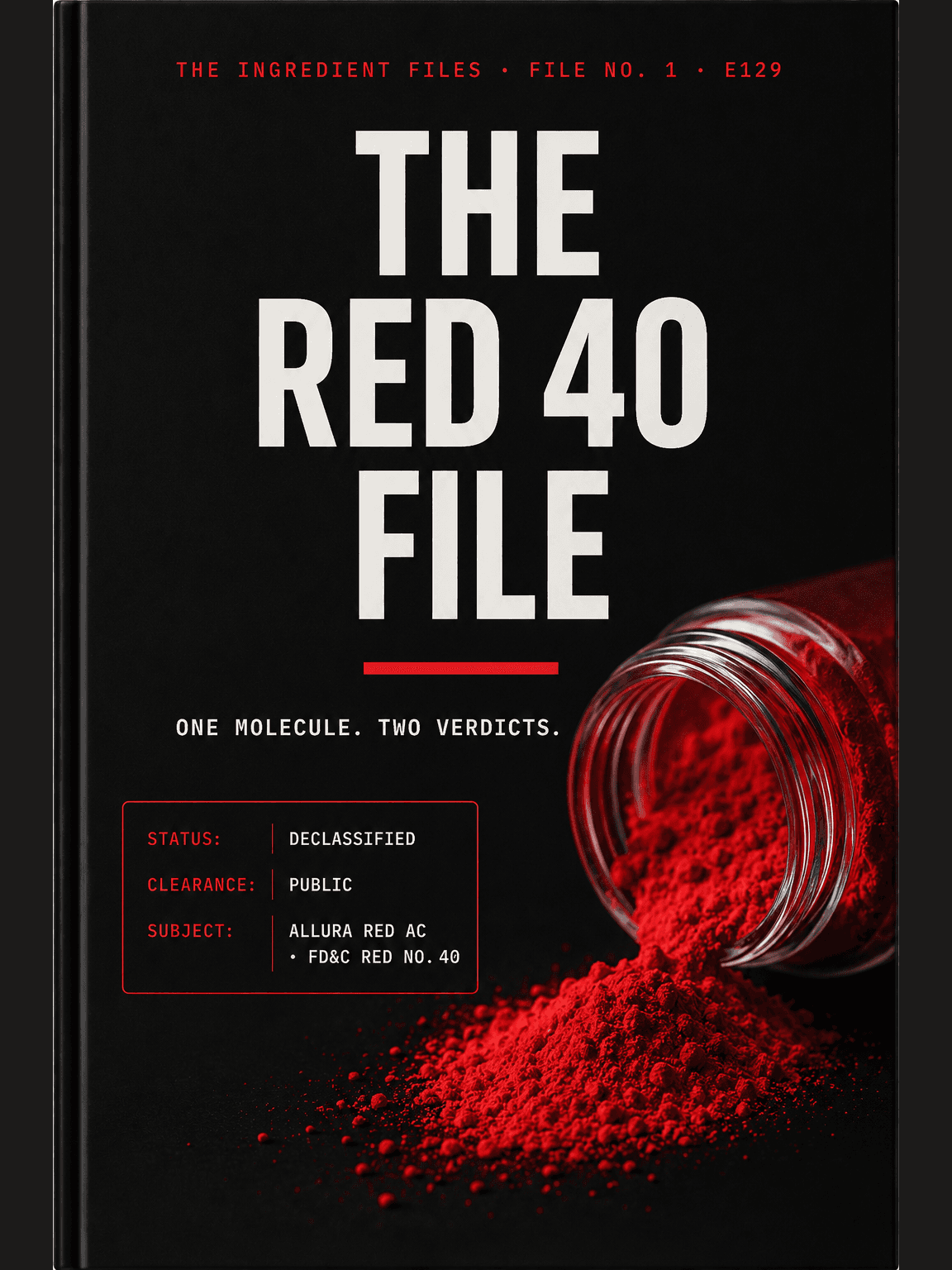
The Red 40 File
One Molecule. Two Verdicts.
How the FDA decides what reaches your table and your medicine cabinet — and how it learned to decide.
Related files
Yellow 5 Tartrazine
The original 'hyperactivity' dye — warning-labeled across the EU.
Open file →Yellow 6 Sunset Yellow FCF
Same EU warning label as Yellow 5. Same silence on US boxes.
Open file →Red 3 Erythrosine
FDA revoked it in 2025 — 35 years after pulling it from cosmetics.
Open file →Titanium Dioxide TiO₂
Out of EU food since 2022. Still whitening US candy and icing.
Open file →