 ALSOFOUNDIN
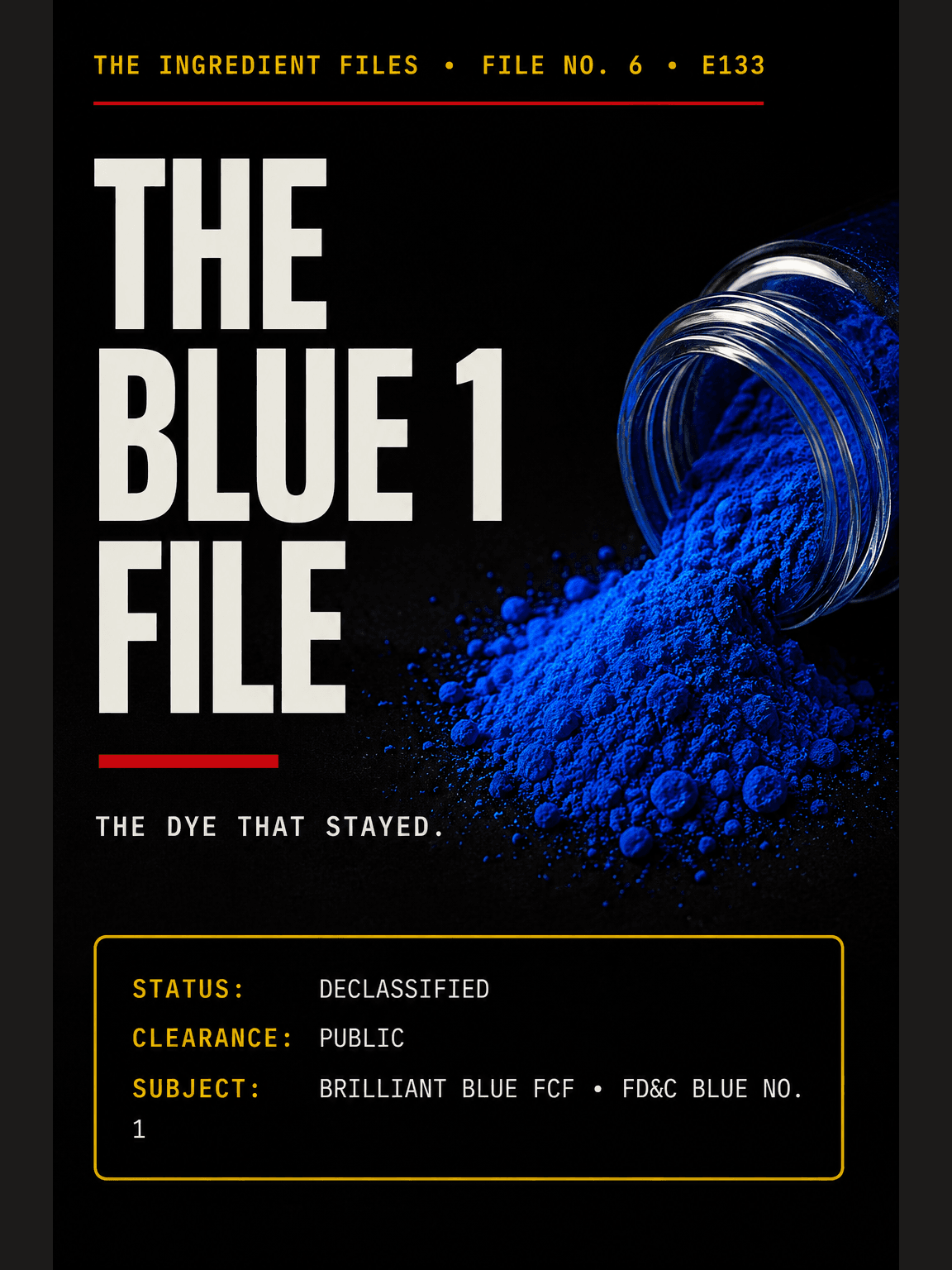
Blue 1 (Brilliant Blue FCF)
ApprovedCleared on both sides of the Atlantic — so far. Also listed on labels as Brilliant Blue FCF, E133, FD&C Blue No. 1, CI 42090.
E-number: E133
What it is
The bright cyan behind blue raspberry everything — a petroleum-derived dye that also builds most food greens when blended with Yellow 5. Very little of it is absorbed by the body; most passes straight through.
Why it's in food
Blue barely exists in nature's pantry, so this is the workhorse: one dye covers blue candy, blue drinks, and half the green foods in the store. It's vivid at tiny doses and stable everywhere.
US vs EU status
United States
FDA-approved with a comparatively quiet record — but not untouched: it's included in the FDA's 2025 petroleum-dye phase-out push, West Virginia's ban, and California's school-food ban, swept in with the dyes that have real rap sheets. One dark historical footnote: in 2003 the FDA warned hospitals to stop tinting feeding-tube formula with Blue 1 after deaths in critically ill patients — a misuse of the dye, since discontinued, not a food-supply issue.
European Union
Permitted as E133 with no warning label — Blue 1 was not among the Southampton six, so it escaped the child-behavior sentence that Red 40 and the Yellows must carry. Europe's regulator re-reviewed it in 2010 and kept it approved.
Common products
- Blue sports drinks and ice pops
- Blue raspberry candy and slushes
- Blue and green M&M's and cereals
- Frosting and birthday cake anything
- Mouthwash and toothpaste
- Green foods, blended with Yellow 5
Cleaner swaps
- Spirulina extract — the natural blue the FDA approved in 2013
- Butterfly pea flower
- Red cabbage juice (shifts blue with pH)
Case note
Blue 1's file is thin, and keeping it that way is the point: a board that stamps every molecule guilty isn't an investigation, it's a haunted house. When the evidence is quiet, the file says so — and then watches whether the 2026 phase-out treats a clean record any differently than a rap sheet.
FAQ
Is Blue 1 actually safe?
Its file is the thinnest in the dye drawer: no EU warning label, no Southampton involvement, low absorption, and clean re-reviews on both continents. That's a genuinely quiet record — quiet enough that this library stamps it gold. The open question isn't past evidence; it's whether being petroleum-derived is now enough, on its own, to end a dye's career.
If it's clean, why is it in the 2025 phase-outs?
Because the new US pressure targets the category, not the individual rap sheets — the FDA's phase-out push and the state bans cover petroleum-based dyes as a class, and Blue 1 is one. It's the difference between convicting a suspect and clearing out the whole neighborhood.
Is blue raspberry a real flavor?
No — it's a color with a backstory. 'Blue raspberry' was invented largely so cherry, strawberry, and raspberry treats wouldn't all look identical red, and Blue 1 is the entire identity. The flavor is a generic fruit blend; the blue is the product.
What's the natural alternative to Blue 1?
Spirulina extract, approved by the FDA in 2013 — it's how naturally-colored blue candies exist at all. It costs more and fades faster, which is why the swap has been slow. Butterfly pea flower and pH-shifted cabbage juice work at home but rarely survive a factory.
The Full File
How the FDA decides what reaches your table and your medicine cabinet — and how it learned to decide.
Related files
Red 40 Allura Red AC
Legal in the US. Child-behavior warning in Europe.
Open file →Yellow 5 Tartrazine
The original 'hyperactivity' dye — warning-labeled across the EU.
Open file →Yellow 6 Sunset Yellow FCF
Same EU warning label as Yellow 5. Same silence on US boxes.
Open file →Red 3 Erythrosine
FDA revoked it in 2025 — 35 years after pulling it from cosmetics.
Open file →